

Something comes up. The 6pm dinner, the Thursday haircut, the dentist you booked a month ago — you’re not going to make it. Fine. All you have to do is cancel.
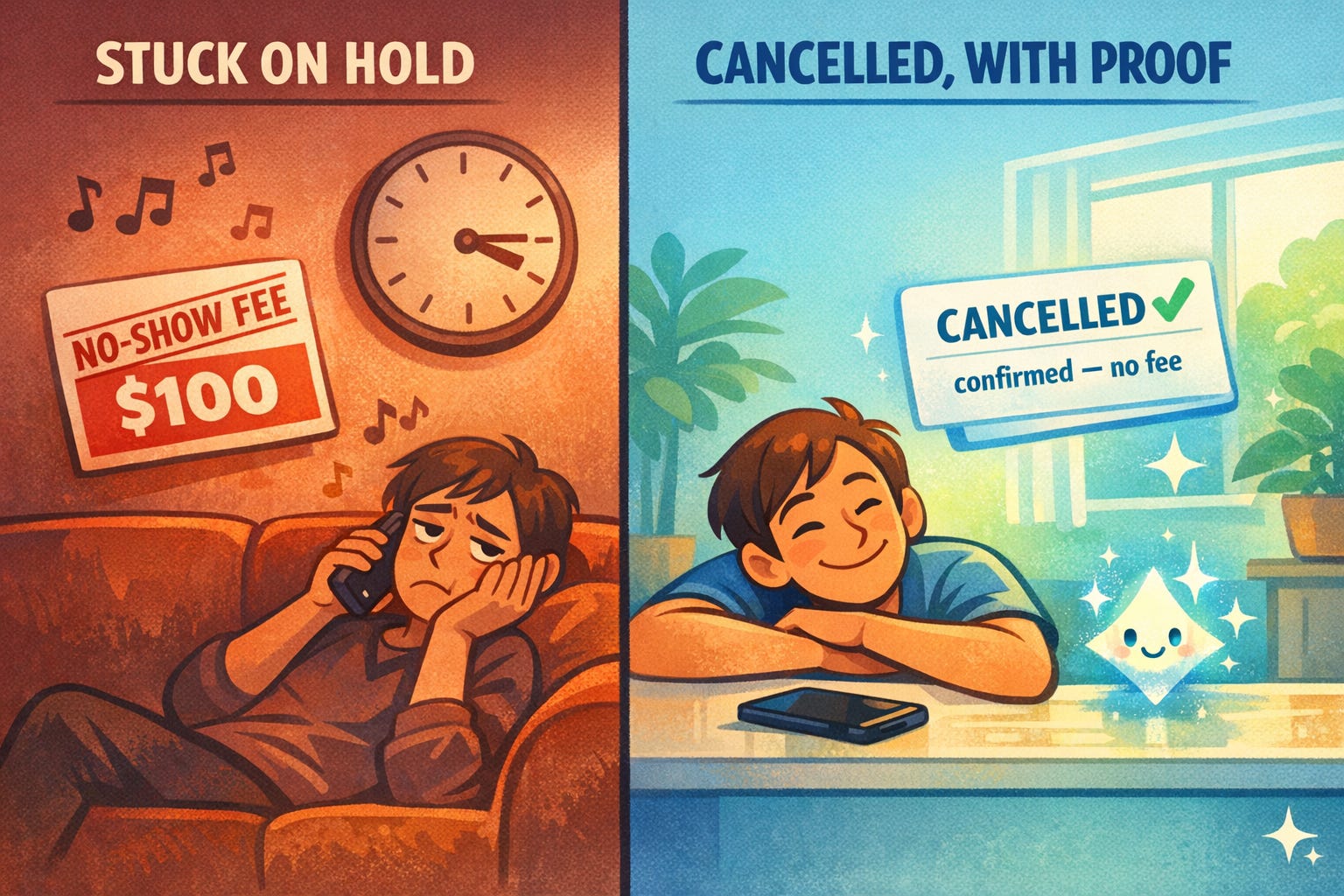
You know how this goes. You put it off, because cancelling means the phone. You finally call at 4:55pm. It rings. It rings again. “Your call is important to us.” Elevator music. You’re on hold, watching the exact minutes tick by that you were trying to save.
One woman told CNBC she tried to cancel a doctor’s appointment twice and sat in “elevator music purgatory for over 20 minutes” each time, never got through — and got a $100 no-show fee in the mail three weeks later. She had tried to cancel. It didn’t matter. There was no proof.
Cancelling got expensive — and hard on purpose
Here’s the uncomfortable part: a lot of places would rather you didn’t cancel cleanly. A cancelled slot is a hole in the day. So cancelling is often made deliberately cumbersome — a number nobody answers, a 24- or 48-hour window, a card kept on file to make the penalty stick.
And the penalties are real:
Doctors and clinics now routinely charge $100–$200 for a no-show.
Restaurants charge $25–$50 a head — a cancelled dinner for six runs into the hundreds, and OpenTable started stacking its own fees on top in 2025.
Salons and therapists hold your card and bill the whole session.
More than half of people say they’d switch providers over a no-show fee. But in the moment you don’t want a fight — you just want out of the booking, cleanly, without the hold music.
What Callomat does instead
You tell Callomat what to cancel — the place, the date and time, the name on the booking. That’s it. You don’t dial anyone.
Alex, our AI agent, makes the call. She waits on hold so you don’t have to, talks to whoever picks up (in their language), and cancels the booking under your name — right away, so you’re not putting it off until you’re already inside the fee window.
Then comes the part that actually matters:
Cancelled. Confirmed by “Marco” at 4:58pm. Reference #4821.
She brings back proof — who she spoke to, when, and a reference number if there is one. So if a “no-show” charge turns up weeks later, you’re not arguing from memory. You have a receipt.
The bit people don’t expect: it works for bookings you didn’t make in Callomat
You don’t have to have booked through Callomat. That reservation you made on the restaurant’s own website, the appointment you booked by phone last month, the table a hotel concierge sorted for you — Callomat can cancel any of them. You hand over the details; it makes the call.
And you only pay if it works. If the cancellation is confirmed, it’s one credit. If Alex can’t get it confirmed — nobody answers, or the place won’t cancel over the phone — you’re refunded, and told plainly: “we couldn’t confirm this — you may still be on the hook, please follow up.” No pretending. No silent failure.
Cancelling, finally, off your plate
Booking was the easy part. Un-booking is the errand nobody wants — the hold music, the awkward call, the fee you might eat anyway. That’s exactly the kind of phone call we built Callomat to take off your hands.
So next time something comes up, don’t dread the call. Tell Callomat what to cancel, and go do the thing that came up instead.
Cancel it for me → callomat.ai